
When evaluating a wealth management relationship, fees are logically one of the first considerations. For portfolios in the $1M to $5M range, an institutional 1.00% fee means paying $10,000 to $50,000 annually. Research-minded clients naturally want to see a clear return on that investment.
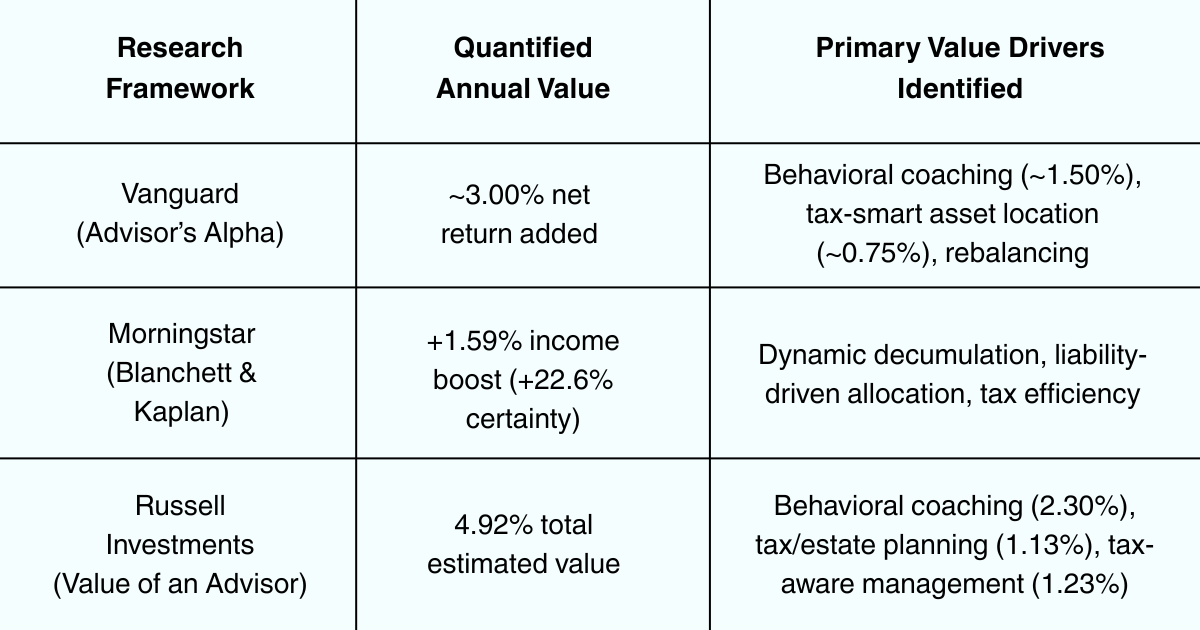
Over the past two decades, academic and industry researchers have attempted to move beyond simple stock-picking to quantify the value added through comprehensive financial planning. Three landmark studies stand out:
The Research: Quantifying Advisory Value
Vanguard: The Shift to Wealth Management
In 2001, Vanguard introduced the Advisor’s Alpha concept, highlighting how advisors generate value through financial planning, tax optimization, behavioral coaching, and relationship-oriented services. At that time, beating the market was the primary pitch, with indexing comprising less than 10% of advisory portfolios.
Vanguard’s 2014 study found that advisors following wealth management best practices could add up to, or exceed, 3% in net returns for clients—driven primarily by behavioral coaching during market volatility and disciplined asset allocation.
Morningstar: Quantifying "Gamma"
In 2013, Morningstar introduced Gamma (Blanchett & Kaplan) to measure the value of intelligent financial planning decisions. Instead of picking hot funds, Morningstar framed portfolio construction around seven core questions every investor should evaluate:
Based on empirical modeling, Morningstar estimated that implementing a gamma-efficient strategy yields up to 22.6% more certainty-equivalent income for retirees, the equivalent of an annual return boost of +1.59%.
Russell Investments: Breaking Down the Numbers
More recently Russell Investments’ framework places the total value of an advisor at 4.92%, breaking it into four distinct areas:
A Healthy Dose of Skepticism
We encourage a healthy degree of skepticism toward claims like "+4.92%." These percentages represent hypothetical maximum estimates across various planning levers. They are neither additive nor guaranteed for every balance sheet. Value always depends on your specific tax bracket, asset mix, and financial complexity.
6 Questions to Ask Any Advisor You Interview
While research proves that skilled advisors add measurable dollar value, the return on your fee depends on the structure of the relationship. When evaluating an advisor, consider asking:
Explore Your Balance Sheet's Structural Efficiency
At SJ Boyle Wealth Planning, we focus on repeatable, practical wealth planning drivers: disciplined asset location, tax optimization, and transparent fee structures tailored to your balance sheet's specific complexity (with annual planning fees starting at $7,000).
If you have a portfolio between $1M and $5M and want an independent review of your tax efficiency and fee structure, we invite you to contact our team.
Schedule a Complimentary Retirement Evaluation
Regulatory Disclosure:
This material is published for informational and educational purposes only and does not constitute individualized financial, tax, or legal advice. Advisory services are offered through SJ Boyle Wealth Planning. Annual minimum fees start at $7,000 and vary based on portfolio complexity and scope of services. Third-party academic research references (Vanguard Advisor’s Alpha, Morningstar Gamma, and Russell Investments) represent hypothetical estimates based on specific market assumptions and do not guarantee future results or specific individual outcomes. Past performance is no guarantee of future returns.

Financial advisor for those who have saved $1,000,000 or more for retirement